A customer has asked for your SOC 2 report, and nobody at your company does security.
You could hire a security lead. You could also give the job to someone you already have, working with their own AI while Kanonik keeps the record. We built Kanonik for that second way.
Plenty of companies would still like someone experienced beside them the first time, and we do that too.
You’d work with qualified security experts who are based in the United States.
It starts with an hour on a call.
We ask how things work at your company today. Who can get into what, where the customer data sits, and what you’ve already written down. We also ask what your customer or your auditor wants, and when they want it. Before the hour is over we tell you what we’d do first and what it would cost. We don’t charge for that hour.
We’d start almost every company on NIST CSF 2.0.
It’s a US government framework that buyers and auditors recognize, and it comes with every Kanonik plan. We build your security program on it. That means your policies, your controls, a list of your risks and a list of your vendors. We write down how things work at your company today, including the parts that aren’t finished yet.
We begin there because a customer’s questionnaire, a SOC 2 audit and an ISO 27001 audit ask many of the same questions in different words. Most of a questionnaire can be answered from this program.
If your customer wants SOC 2 or ISO 27001, the work still starts here. We don’t build you a second program. Kanonik counts each control toward every framework it covers.
There are three ways we can look at your systems, and you choose.
When we ask how things work, people often tell us how they’re meant to work. The auditor will look at what really happens, and we want the program to say that. So before we write anything, we find out which systems you have, who can get into them and where the gaps are.
Inside your company
The way we’d choose is to work inside your company. You connect your own AI to your Kanonik workspace. Our consultant then works through your systems with one of your people, using that AI. Everything stays inside your company’s accounts. Your person sees every step, and that is how they learn to run the program afterwards.
A read-only account
The second way is a read-only account for us. We send you the exact permissions first, for each system you choose. That might be your identity provider, your cloud account and your code host. You create the account. Our consultant’s AI reads your systems through it, and it can’t change anything. When our work ends, you close it. This way takes the least of your team’s time.
No access
The third way needs no access. You add our consultant to your Kanonik workspace as an author. We give you a guide to what we need and the form to send it in, with prompts you can hand to an AI to pull it together. Then you send us what you have. It takes longer, and the program can only be as good as what we receive.
Inside your company the AI is your own, so your provider bills you as usual. The other two ways, our consultant uses ours. We don’t charge you for that.
Whichever way you choose, Kanonik never connects to your systems itself. With the read-only account, it’s our consultant who logs in.
Some things always come to us by hand. Your staff list from HR is one, because we never ask for access to an HR system.
After we’ve built the program, your own people can run it.
On a Monday, someone on your team asks their AI what’s waiting. It reads the weekly summary Kanonik prepares and says what to look at first. The work is mostly reading what the AI has drafted, then approving it or sending it back.
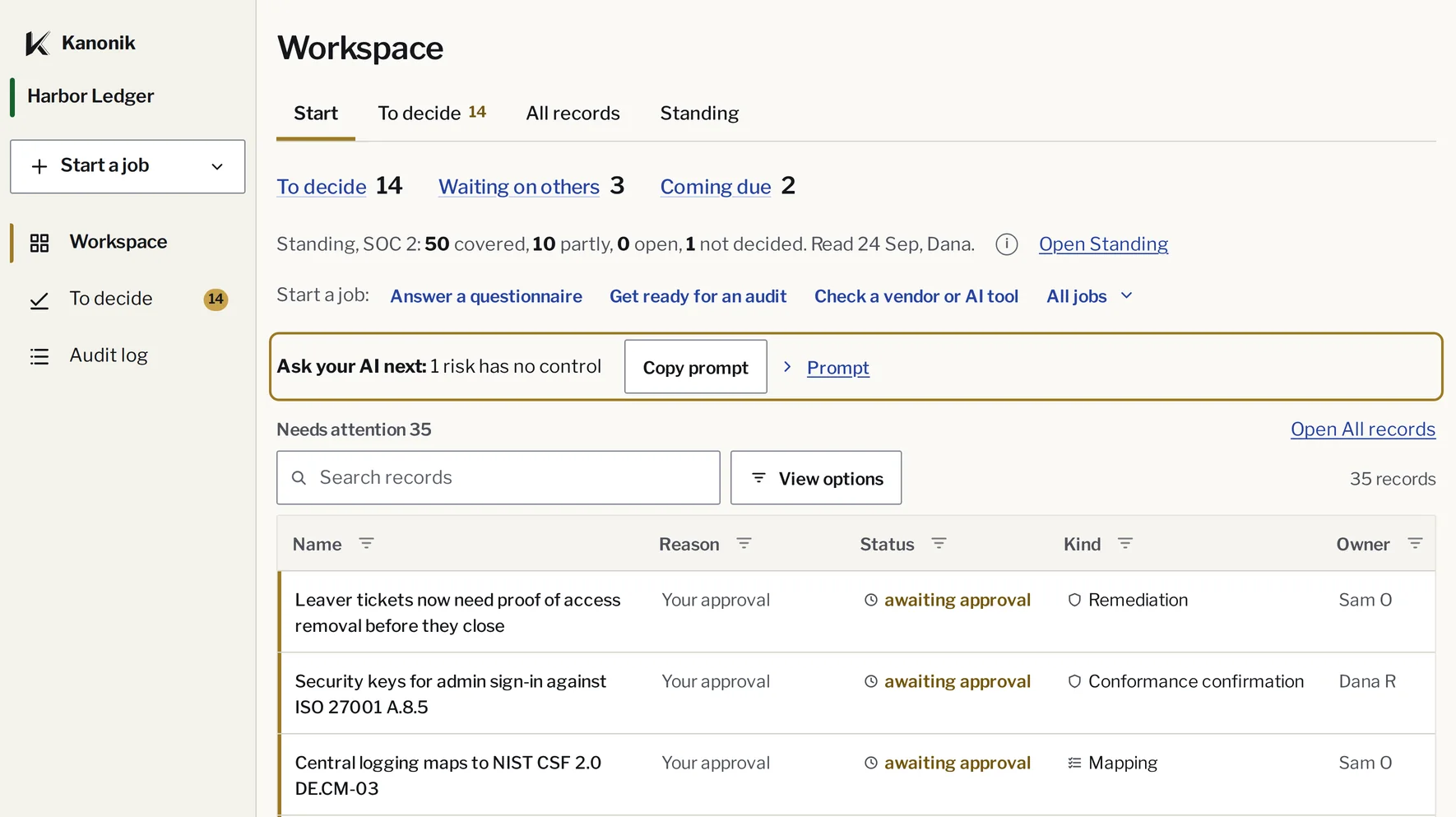
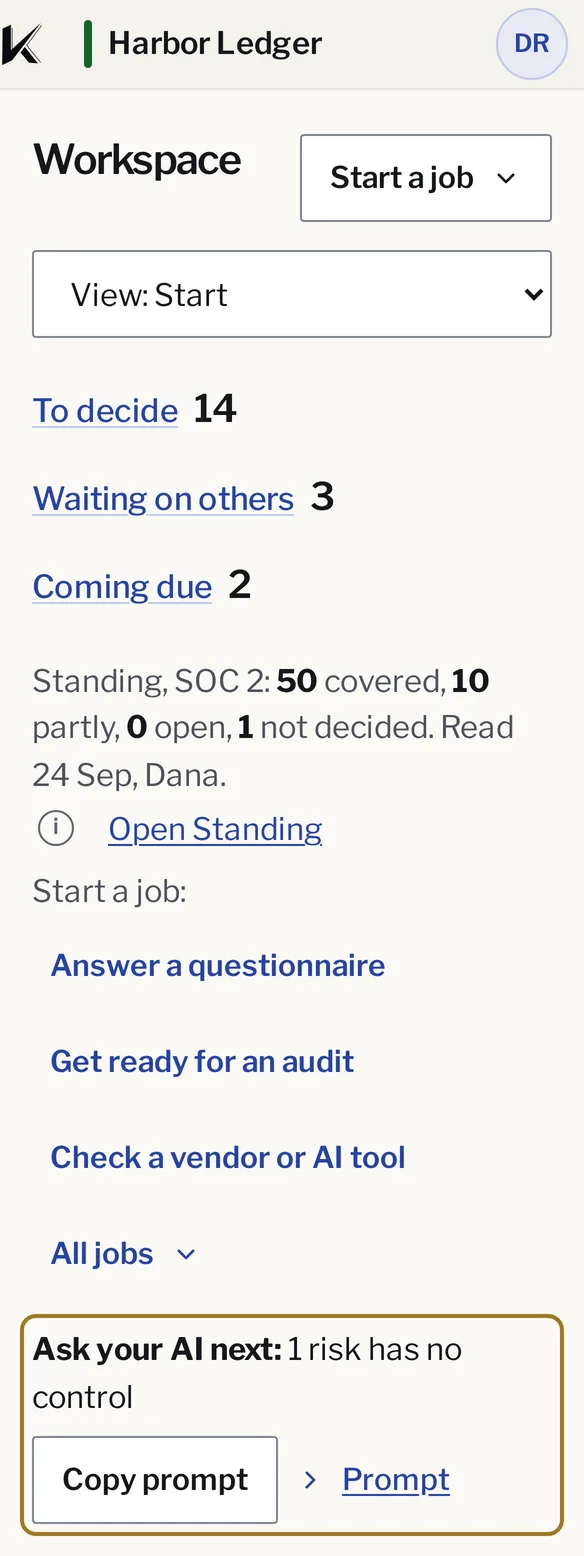
What’s waiting, and what to ask your AI next.
The Workspace start page in Kanonik, with sample data from Harbor Ledger.
When a new questionnaire arrives, the AI answers it from what your company has already approved. It marks the questions it couldn’t answer, and those are the ones a person has to think about.
Nothing goes on the record until someone at your company approves it. That can be anyone who knows how the company works. They don’t need to be a security specialist.
Before we finish, we go through a week’s work with the person who’ll run the program. If they don’t have an AI connected to Kanonik yet, we set that up with them first.
We’d like to hand over a program you can run without us. You can still call us whenever you want a second opinion.
Here is what our work costs.
The program
$7,500
Building the program takes four to six weeks and costs $7,500. You also get a list of what’s missing, with a date against each item.
A questionnaire
$1,800
Sometimes a questionnaire is holding up a deal and can’t wait for a program. Send us the file your customer sent you, and we draft the answers. You approve each one before it goes back. If you approve as we go, it takes five working days. The price is $1,800 for up to 200 questions, and $150 an hour for anything beyond that.
Audit preparation
$15,000
Getting ready for an audit usually means SOC 2 or ISO 27001. We get your program and your evidence to the point where an auditor can start, and we stay with you through the auditor’s questions. We can’t promise what an auditor will say, and we’d be careful with anyone who does. Starting from nothing, it takes eight to twelve weeks and costs $15,000. That includes building the program. If we’ve already built your program, audit preparation is $7,500.
HIPAA has no official certificate, but customers and regulators do review it. We prepare you for a HIPAA review too, at the same prices.
A part-time CISO
from $1,500 a month
Some companies want a part-time CISO after that. We join your customers’ security calls, write the board update, and read what a vendor’s contract says about security before anyone signs. It’s monthly, from $1,500 for ten hours, with three months to begin with.
Anything else
$150 an hour
You’ll know the price of the program, a questionnaire or the audit preparation before we start.
These prices don’t include the audit itself. The audit firm quotes that to you.
You’ll also need a Kanonik plan and, by handover, an AI of your own.
Starter covers a first program or a questionnaire, and it’s $300 a month. You’d move to Audit-Ready, at $6,000 a year, when you go for an audit. The plan costs the same whether you use our services or not.
Kanonik works through an AI such as Claude or ChatGPT, and the plan price doesn’t include one. After handover the program runs on your AI.
Some of the work has to be done by someone else.
There are five things we don’t do. Where you need an outside firm, we’ll help you choose one and we’ll work alongside it. You sign with that firm and pay it directly. We take nothing from them.
- A CPA firm or an accredited body
We don’t do the audit.
A SOC 2 report comes from a licensed CPA firm, and an ISO 27001 certificate comes from a body accredited to issue one. Whoever built your controls can’t be the one who audits them.
- A security testing firm
We don’t do the penetration test.
Testing whether someone can break in is a specialty of its own, and we don’t practice it.
- Your IT team or IT provider
We don’t set up your systems.
Single sign-on, device management, backups and logging stay with your IT team or your IT provider. We’ll say what needs to be in place, and we’ll check that it is. We only read your systems, whichever way you pick. If a setting needs changing, your own people change it.
- An independent internal auditor
We don’t do the ISO 27001 internal audit.
The standard wants it done by someone who didn’t build the program, and we built it.
- Your lawyer
We don’t give legal advice.
We’ll read a contract for what it says about security. The rest of it is for your lawyer.
The workspace is yours.
Everything we write for you goes into your own Kanonik workspace. If we stop working together, all of it is still yours. You can carry on by yourselves or with a consultant of your own. Consultants use Kanonik too, and their seat is free.
Tell us what your customer or your auditor has asked for.
A few lines will do: what they asked for, and when they want it. We reply within two working days to set up the call. If it’s really a job for one of the firms above, or for another consultant, we’ll tell you.