Foresight shows you which promises to your customers a new vendor or a change would break.
Engineering has found another backup provider. Its contract keeps backups for 14 days, and your questionnaire answers promise 30. Somebody should catch that before the contract is signed.
We built Foresight to catch it. Ask before you sign, and you get a row for each promise your team has approved, with the reason beside it.
An engineer at Harbor Ledger, to the team’s AI
We’re moving our database backups to Brookvale Backup on 3 November. Does that break anything?
1 Scope
1.1 Agreement. This Addendum is the data processing agreement between Brookvale and Customer under Article 28 of the GDPR.
2 Backups
2.1 Backups. Brookvale takes a backup of Customer Data every day.
4 Retention and location
4.2 Retention. Brookvale keeps each Backup for fourteen (14) days after it is taken and then deletes it.
4.3 Location. Brookvale stores all Backups in its data centers in the United States.
Nothing here about AI training.
Not in the addendum. Dana: we tell our customers on 24 October.
Brookvale Backup, confidentialExtract
4.3 Location. Brookvale stores all Backups in its data centers in the United States.Backups stored inUnited StatesApproved
4.2 Retention. Brookvale keeps each Backup for fourteen (14) days after it is taken and then deletes it.Backups kept for14 daysApproved
Not in the addendum. Dana: we tell our customers on 24 October.Notice planned, if24 OctoberApproved
1.1 Agreement. This Addendum is the data processing agreement between Brookvale and Customer under Article 28 of the GDPR.Processing agreementIn placeApproved
Nothing here about AI training.AI trainingNot statedApproved
Dana Reyes approved 5 facts.
Customer data is stored only in the EU, backups included
ConflictBrookvale stores backups in the United States.
Who you told. Approved questionnaire answers that make this promise
- Northshore Bank
- Crestmoor Insurance
Backups are kept for 30 days
ConflictBrookvale keeps them for 14.
Customers get at least 30 days’ notice before a new sub-processor
Conflict, if notice goes out on 24 OctoberThat’s 10 days before go-live.
Every sub-processor has signed a data processing agreement
No conflict, for Brookvale onlyBrookvale has one in place.
Customer data is never used to train AI models
Needs informationThe addendum doesn’t say.
Nothing is recorded.
How to read the result
- Conflictthe change would break this promise.
- No conflictthe promise still holds.
- Needs informationa fact is missing, so the row doesn’t pass.
A result that says “if” rests on a date you gave. Change the date and run it again.
Here’s what happens when Harbor Ledger checks a new backup vendor.
Harbor Ledger is a sample company that keeps its customers’ data in the EU.
- An engineer
Someone says what’s changing.
An engineer asks the team’s AI assistant, which is connected to Kanonik: “We’re moving our database backups to Brookvale Backup on 3 November. Does that break anything?” The AI asks when Harbor Ledger plans to tell its customers. The answer is 24 October.
- The team’s AI
The engineer points the AI at Brookvale’s contract.
It’s Brookvale’s data processing addendum. The AI reads it and proposes the facts the promises need, each with its clause. Brookvale takes backups (clause 2.1), keeps each one for 14 days (4.2) and stores them in the United States (4.3). The addendum itself is the data processing agreement between Brookvale and its customer (1.1). It says nothing about training AI models, so the AI records that one as unknown instead of guessing.
- Dana
She approves the facts.
Dana runs security at Harbor Ledger. She gets the request as a link and reads each fact beside its clause before she approves. The AI doesn’t run the check until she has.
- Foresight
It checks five promises.
The result is the Foresight check at the top of this page. Three promises come back Conflict, one holds for Brookvale, and one needs information.
Foresight also lists which of Harbor Ledger’s approved questionnaire answers make a promise that came back Conflict or Needs information. Here, those are the answers on EU storage and AI training, so Dana knows which ones to reread. The result says what it didn’t check, too, such as the migration itself.
- Dana
The decision is hers.
Foresight won’t approve the move or block it, and it never says a change is compliant. That’s for Dana to decide. She now knows which promises are at stake, and what she needs to ask Brookvale.
Pick a later go-live date and run the check again to see which rows change.
Foresight treats the dates you give it as assumptions. Every row that depends on one says “if”.
Dana asks the AI to try 3 December instead. It runs the check again and shows the whole table. Notice still goes out on 24 October. That’s now 40 days before go-live, and the notice row turns to No conflict. The storage row stays a conflict, because the backups would still be kept in the United States.
Try as many dates as you like. A check changes nothing on your record and needs no approval.
A person on your team approves every fact Foresight uses.
Your customers will hold you to these promises, so someone on your team checks each fact against the contract before Foresight uses it.
You might wonder how Kanonik knows what the vendor’s contract says. It doesn’t. Your AI reads the contract on your side and sends Kanonik each fact with its clause and a fingerprint of the file. Kanonik never sees the file, so the record says plainly that the fingerprint came from your AI.
That means Kanonik can’t tell whether the AI read the contract correctly. It checks that each fact is complete and makes sense, and then a person checks the reading.
You get the same result every time from the same promises and facts.
The AI reads the contract and shows you the result, but it doesn’t decide the result. Kanonik’s server does. It compares your approved promises with the approved facts the same way every time, and no AI model takes part.
We built it that way because, months from now, someone may ask why you went ahead with a vendor. Every result comes with a replay reference. Keep it with your notes on the decision. Send it back, and Kanonik runs the check again at the same point in your record, on the same promises and facts. You get the result you saw that day.
A missing fact never counts as a pass. The row says Needs information and names what’s needed.
Some rows rest on how a word should be read. Foresight counts a backup copy as storage, for example, because under the GDPR storing data and holding a copy are both processing (Article 4). When a row rests on a reading like that, the result names it, so you can see the reading and disagree with it.
Foresight checks the promises your questionnaire answers already make.
It checks five kinds of promise.
- Storage
- Where customer data is stored
- Backups
- How long backups are kept
- Agreements
- Whether every sub-processor has signed a data processing agreement
- Notice
- How much notice customers get before a new sub-processor
- AI training
- Whether customer data is used to train AI models
These promises get made one questionnaire at a time. Nobody rereads them once the questionnaire is sent, except the customer who received it, on the day something goes wrong.
So Kanonik saves them as you answer. When you answer a questionnaire with your AI and an answer states one of these promises, the AI shows you how Kanonik will check it. You approve the answer and that reading together. From then on, every vendor check includes it. If you haven’t answered a questionnaire that way yet, there’s nothing to check against. Your AI offers to set up the five promises with you, and you approve each one like any other answer.
The change can be a new vendor, a vendor you’re replacing or another change you’re planning. An AI tool counts as a vendor, so the AI note-taker your sales team wants to try goes through the same check. Each vendor in the change has to be on your record first. If it isn’t, the AI proposes it and someone approves it like any other vendor.
You can start a check wherever the change turns up.
- Anyone on your team
In your own AI chat.
Anyone in your workspace can ask their own AI. Say it the way you’d tell a colleague, with the vendor and the date.
- Whoever has the page
From a photo of the contract.
Sometimes the contract is a printout on someone’s desk. Photograph the page and send it to the chat. Kanonik keeps each fact with its clause number and the photo’s fingerprint.
- Your AI
From the vendor’s PDF or web page.
Your vendor may send its data processing agreement as a PDF or publish it on its website. Point your AI at either one. For a web page, Kanonik keeps the address with each fact.
- You
From the Kanonik app.
In your workspace, choose Start a job, then Check a vendor or AI tool. Kanonik copies a prompt for you. Paste it into your AI, and it asks for whatever it still needs.
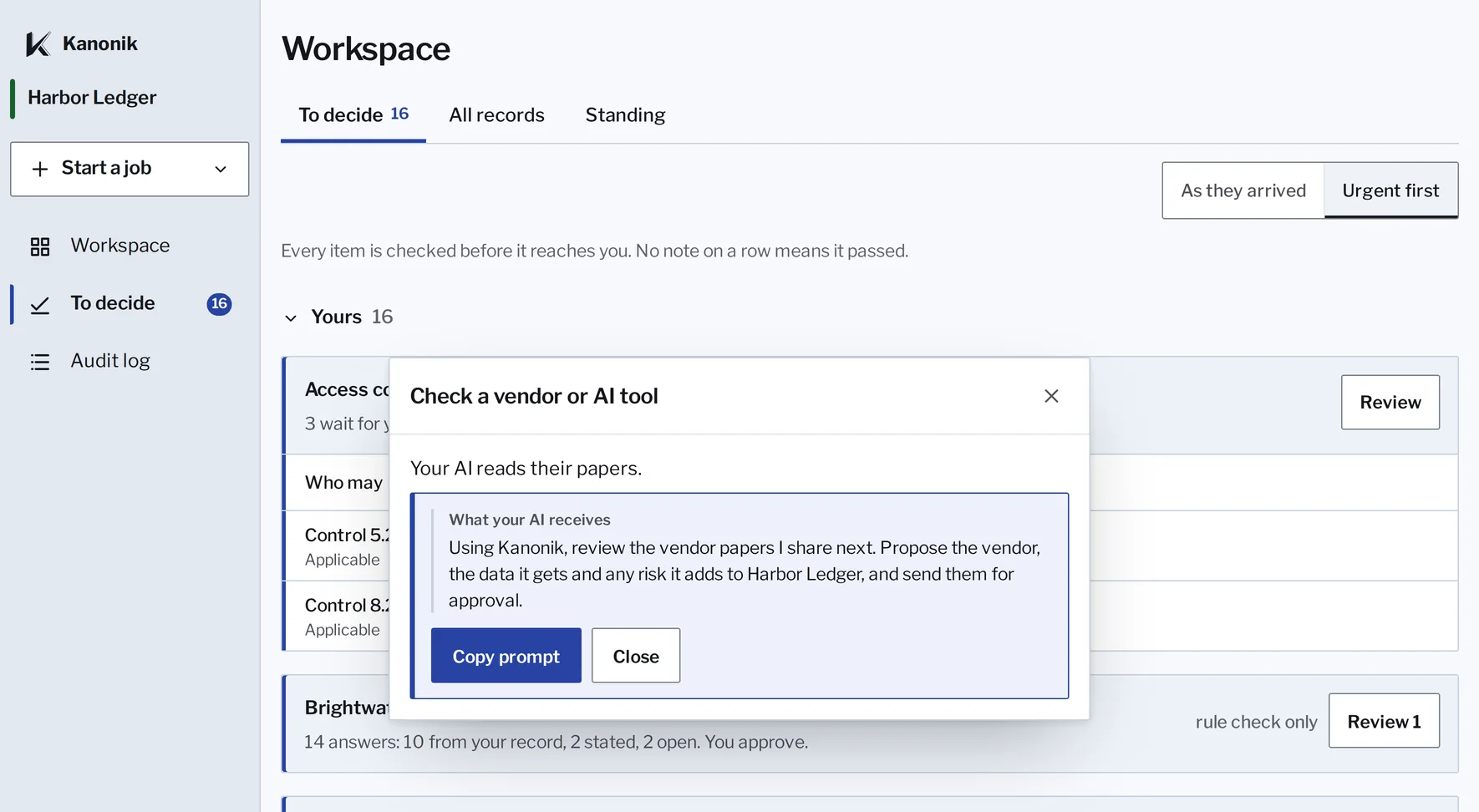
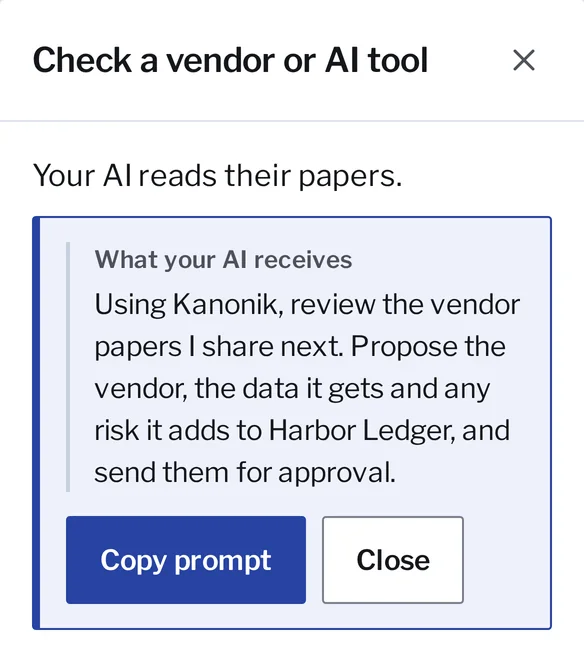
The prompt Kanonik copies for you. Nothing is recorded until someone approves it.
Start a job in Kanonik, with sample data from Harbor Ledger.
Try Foresight on the next vendor your team wants to sign.
Foresight is in every plan, Starter included, and in the trial. We believe any company that makes promises to its customers should be able to check them before it signs with a new vendor.
If your team has answered a questionnaire with your AI in Kanonik, and confirmed how Kanonik will check those answers, you already have promises Foresight can check.