Compare: enterprise GRC

Kanonik for organisations that cannot afford the GRC monsters.

ServiceNow IRM, Archer, MetricStream, IBM OpenPages, OneTrust, Diligent, Riskonnect, SAI360, NAVEX, SAP GRC, LogicManager, Workiva, AuditBoard, and LogicGate are built for enterprises with a risk function, a procurement department, and an implementation budget. A 45-person fintech has none of those and still has to pass the same audit. Kanonik is new-gen GRC for that team: self-serve, $99 a month, your own AI does the work, and every change is verified, approved by a person, and sealed into a record your auditor checks offline.

The structural difference

A platform you administer, or a record you can prove.

Enterprise GRC platforms are workflow engines: modules for risk, audit, policy, and third parties, configured by consultants, priced per module, and operated by a team. Kanonik has no modules to configure and no workflow to administer.

Time to first record

The same afternoon, not the same fiscal year

Enterprise GRC implementations are measured in quarters and usually include an implementation partner. Kanonik is self-serve: sign up, connect the AI client you already use over MCP, load a signed skill, and land the first approved record the same afternoon. There is no sales call and no professional services line.

Who does the work

Your AI drafts, a person approves

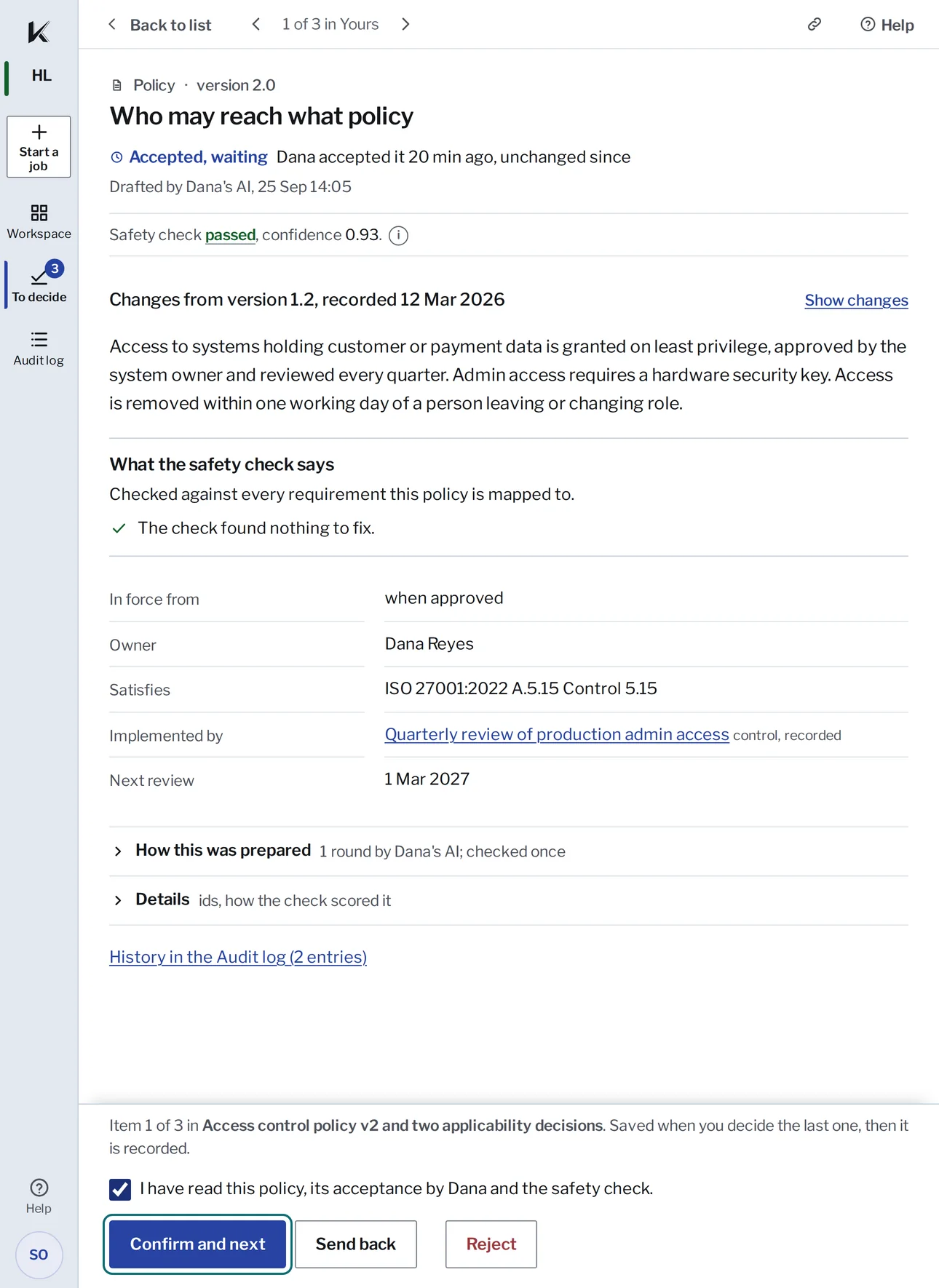
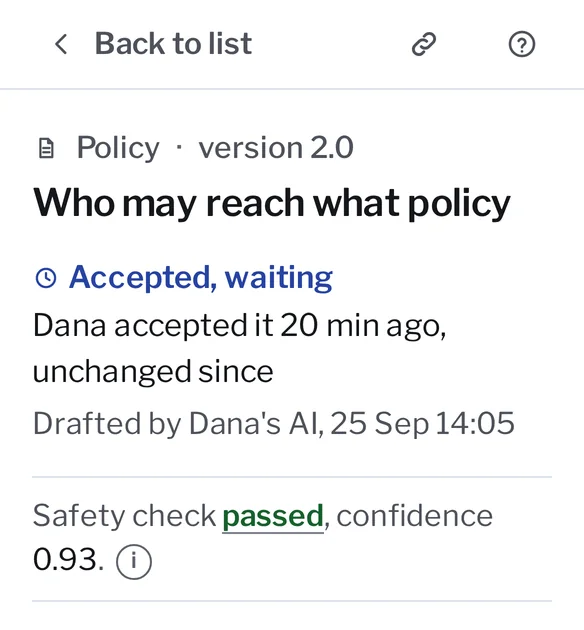
Instead of a team keying controls, risks, and policies into forms, your own AI proposes them. A non-bypassable server-side Verifier checks every proposal, rule tier then model tier, and a signed single-use approval token gates every write. Nothing lands without a named person clicking.

What the auditor gets

A chain, not a report builder

Every change is an event on an append-only, FIPS-signed hash chain kept for seven years. The Auditor Export is a signed bundle with an open-source verifier the auditor runs offline. Point-in-time recall returns the program exactly as it stood on any date, without a reporting module.

Price and terms

A line item, not a procurement project.

Solo is $99 a month or $990 a year with one user and one framework. Pro is $399 a month or $3,990 a year. Extra users are $9.99 a month, additional frameworks $499 one-time, and the Proof Snapshot is free and unlimited on both plans. The base price changes only by a sealed public event and never rises at renewal. Both plans open with a 14-day card-required trial; there is no free tier.

Frameworks load as versioned packages: ISO 27001:2022, SOC 2, GDPR, NIST CSF 2.0, and HIPAA today. Controls and evidence are authored once and projected onto every activated framework.

The platform names on this page are trademarks of their respective owners. Kanonik has no business relationship with any of them and does not connect to, import from, or write to their platforms.

Where the enterprise platforms still win

Enterprise risk management across business units. Internal audit management, whistleblowing, and board reporting. Third-party risk at scale. On-premises deployment, ERP integration, and vendor certifications a large-company procurement team requires. If you have a risk function of ten people and a hundred business units, that is what these platforms are for.

Where Kanonik wins

You are a 25 to 200 person company where compliance landed on a founder or an engineer. You already use an AI assistant for the work. You need a record an auditor will accept, at a price that does not need a budget line, without anyone administering a platform. Kanonik replaces the GRC category for that team rather than shrinking an enterprise one.

Frequently asked

Questions teams priced out of enterprise GRC ask us.

Is Kanonik an alternative to ServiceNow IRM, Archer, or MetricStream?

For a 25 to 200 person company, yes. Those platforms are enterprise workflow engines configured by consultants and priced per module. Kanonik is self-serve new-gen GRC where your own AI does the work, a server-side Verifier checks every change, a person approves it, and the record is sealed for the auditor. It is not a scaled-down enterprise platform; it is a different shape.

Does Kanonik integrate with our existing enterprise GRC platform?

No. Kanonik ships no connectors to any GRC platform or source system, by design. It replaces the GRC tool for the teams it is built for. Your AI can read your existing exports through its own tools and propose the equivalent record in Kanonik, and every proposal passes the Verifier and your approval first.

How long does it take to get a first approved record?

The same afternoon. Sign up self-serve with a card, connect your AI client over MCP, load a signed Kanonik skill, ask it to draft the first control or risk, and approve the result from the link it sends you. There is no implementation project and no professional services engagement.

What does Kanonik cost compared with enterprise GRC?

Solo is $99 a month or $990 a year; Pro is $399 a month or $3,990 a year. Extra users are $9.99 a month and additional frameworks $499 one-time. There is no per-module pricing, no implementation fee, and the base price never rises at renewal. Enterprise and air-gapped deployments are by contact.

Which frameworks does Kanonik support today?

ISO 27001:2022, SOC 2, GDPR, NIST CSF 2.0, and HIPAA, loaded as versioned packages so a control authored once maps across every activated framework. PCI DSS is not available yet. Kanonik holds no certification of its own and never implies one.

Runs ISO 27001:2022, SOC 2, GDPR, NIST CSF 2.0, and HIPAA today. Solo is $99 a month, Pro is $399, and the base price never rises at renewal.

The proof is the product.